Blackjack Basic Strategy Chart: Pick the Right Chart for Your Table and Cut Your Error Cost from ~0.5% to ~0.14%
Estimated reading time: 6 minutes
Key takeaways
- Match the basic-strategy chart to the table rules (decks, S17/H17, DAS, surrender, payout).
- Memorize five high-impact rules first to eliminate most common mistakes.
- Use focused drills and a no-chart pressure session to make correct plays automatic.
How to choose the right blackjack basic strategy chart
Charts aren’t interchangeable.
A chart for single-deck, dealer-hits-on-soft-17, surrender-allowed blackjack will give different advice than the chart for an eight-deck S17 table with no double-after-split.
So the first job at the table is a simple checklist.
- Count the decks. One, two, four, six, eight — charts vary. Wizard of Odds explains why deck count matters and gives comparative house-edge numbers for different deck counts.
- S17 or H17? If the dealer hits soft 17 (H17) you need a slightly different chart than when the dealer stands on soft 17 (S17).
- Doubling rules. Is double allowed after splitting (DAS)? Can you double on any two-card total or only certain totals?
- Surrender. Late surrender available? If yes, the chart will include surrender spots (R) and fallbacks.
- Blackjack payout. Is natural blackjack paid 3:2 or 6:5? (3:2 is the usual standard for basic-strategy math.)
- Dealer checks for blackjack. Does the dealer peek for blackjack before you act? That changes some split/double plays.
If you want to check your table against the exact math, use a strategy calculator that lets you plug in the exact rules and get a matching chart and expected numbers.
That’s the only reliable way to be sure you didn’t miss a rule that shifts a handful of key decisions.
Read a blackjack basic strategy chart like a pro
Most charts are split into three blocks.
Learn how those blocks map to the decisions you’ll face.
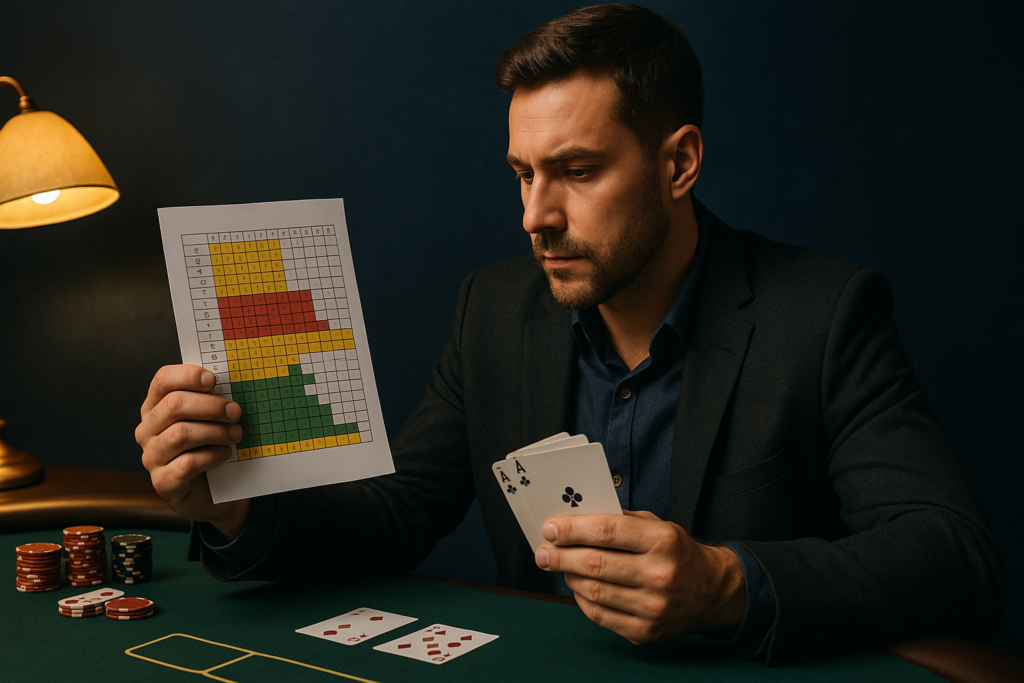
- Hard hands: No ace counted as 11. These rows are usually labeled 5–17+ and tell you when to hit, stand or double.
- Soft hands: Hands with an ace counted as 11 (for example A-6 is soft 17). These have different rows because the ace gives flexibility.
- Pairs: Two cards of the same rank — this section tells you when to split (P) or take the fallback action if splitting isn’t allowed.
Common abbreviations you’ll see:
- H — hit
- S — stand
- D — double if allowed; otherwise hit
- DS — double if allowed; otherwise stand
- P — split
- R — surrender if allowed; otherwise the fallback (usually hit or stand)
Example: on a six-deck, dealer-stands-on-soft-17 chart you’ll see “stand on 12–16 vs dealer 2–6” in the hard-hand block.
That’s not opinion — it’s the mathematically best play for those matchups based on the rule set.
Five high-impact rules to memorize first
These five moves give the biggest bang for your memory effort.
They’re the ones that cut the most error cost if you make them automatic before you worry about rarer, tiny-edge plays.
- Stand on any hard 17 or higher. No drama. If your two or more cards total 17 and there’s no usable ace, stand.
- Hit hard 11 or lower. You can’t lose by taking another card on totals of 11 or less; doubling is sometimes correct, but hitting is safe as the default.
- Stand on hard 12–16 vs dealer 2–6. Dealer upcards 2–6 are “bust-prone” — the dealer must draw and is more likely to fail to reach 17. These are your conservative stands.
- Double hard 10 and 11 against weak dealer upcards. When the dealer shows a 9 or lower (exact cutoffs depend on the chart), doubling a 10 or 11 is often the right move because you’re in a strong position to win extra money on a single card.
- Always split aces and eights; never split tens or fives. Splitting aces and eights turns problematic hands into opportunities; tens are already strong and fives play better as a 10 that you can double.
Those rules alone mirror the simplified list Wizard of Odds uses for practical learning, and they eliminate a big chunk of common mistakes.
Drills and a practice routine that actually stick
Being able to rattle off the five rules is one thing.
Playing them under casino pressure is another.
Here’s a realistic routine I use and recommend.
Warm-up: 5 minutes — section focus
Pick one section per day: hard hands Monday, soft hands Tuesday, pairs Wednesday.
Run through 50 random hands from that section using a chart beside you, timing each decision.
Aim for 2–3 seconds per hand.
Core: 10–15 minutes — mixed-deck simulator
Use an app or shuffled deck to simulate real play.
Force yourself to call the action out loud without looking at the chart once you’ve practiced it enough.
If you screw up, stop and check the chart, then reset the shoe and replay the hand until it’s automatic.
Pressure: 10 minutes — “no-chart” half
Play a full shoe (or app session) without the chart.
Keep the chart next to you but out of sight.
Only consult it when you absolutely don’t know. This mimics the table setting where you might be embarrassed to check every time.
Weekly review: 20 minutes — the annoying edges
Go back to the odd cases you always forget: soft 18 vs dealer 9, pair-splitting exceptions, when surrender trumps doubling.
These rare decisions cost small amounts individually but add up across sessions.
Practical tip: do the drills with a friend to simulate table chatter, and bring a small laminated chart to the casino (most houses allow charts).
The goal is to make the chart your training wheels, not a permanent prop.
Why the six-deck S17 example matters — the numbers to hold in your head
Let’s anchor the improvements to a real rule set so the percentages mean something.
Wizard of Odds gives a useful benchmark: for a six-deck game where the dealer stands on soft 17, the house edge when you play correct basic strategy is about 0.41%.
By contrast, using a simplified or incomplete strategy raises the effective cost of imperfect play.
Wizard of Odds cites a scenario where a simplified strategy costs about 0.53%, while a complete basic strategy reduces that imperfect-play cost to about 0.14% relative to the same rule set.
That’s the ~0.5% to ~0.14% improvement people talk about.
Deck count changes the math, too.
Wizard of Odds lists illustrative house edges for different deck counts under comparable assumptions — for example, one deck can be as low as about 0.014% while eight decks can be around 0.577%.
Those numbers show why selecting the correct chart by deck is meaningful.
So when you find a six-deck S17 table, think: get the six-deck S17 chart, learn those five rules, and you’re already cutting a measurable chunk of cost compared with playing by feel.
Want the exact charts for common deck counts? Wizard of Odds publishes charts for specific decks, including a four-deck basic strategy chart and tools that generate charts for particular rule combinations.
Small-but-critical rule checks at the table
Before the first hand, do this quick five-question check out loud in your head or with your mates:
- How many decks?
- Does dealer stand or hit on soft 17?
- Is doubling after split allowed?
- Is surrender an option?
- Does blackjack pay 3:2 or 6:5?
Those answers determine which blackjack strategy chart you pull up.
If you get even one of them wrong, a handful of plays each session can be off and the cost adds up.
If you want to read a short Q&A that covers the most common simplifications and why they’re safe starting points, Wizard of Odds’ ask-the-wizard basic strategy write-up is a great, compact reference.
One more practical note: charts assume the casino is paying standard blackjack odds (usually 3:2).
If you see oddball payouts like 6:5, the math changes and you should re-evaluate whether the game is worth playing at all.
And yes — set a fixed gambling budget before you start.
Basic strategy improves decision quality but it doesn’t erase variance or guarantee profit.
How long does this take?
If you practice 20–30 minutes a day for two weeks with focused drills, you’ll be at the level where most common decisions are automatic.
Rarer exceptions take longer but have much smaller effect on your overall cost.
Use the right chart, not the one you “feel” is best
Memorization and discipline beat intuition at blackjack.
The math doesn’t care how confident you feel about a hand.
When you pick the correct chart for the table rules — deck count, S17/H17, DAS, surrender and payout — and make the five high-impact plays second nature, you’ll shave off a predictable chunk of expected loss.
For the six-deck S17 benchmark, that looks like moving from a roughly 0.5% imperfect-play penalty down toward ~0.14% with good play, and keeping your house-edge baseline near the ~0.41% level when you use correct basic strategy.
If you want to check how different rule tweaks change expected outcomes, the Wizard of Odds site explains how deck count and other rules move the house edge; see their piece on why number of decks matter for the comparative figures.
Play the correct blackjack basic strategy chart, follow the five rules, run the drills, and you’ll stop giving the house money because you hesitated or guessed.
That’s the whole point.
One thing to remember: matching the exact chart to the table rules is the single easiest way to cut the largest chunk of avoidable loss.
Do that first, then worry about the tiny edge plays.
Frequently Asked Questions
Is a blackjack basic strategy chart legal at the table?
Yes, most casinos allow players to consult a chart at the table. If in doubt, ask the dealer. Using the chart is a learning tool; it’s not cheating.
Do charts change when the dealer hits soft 17?
Yes. H17 vs S17 changes some soft-hand and surrender strategies. Always use a chart that matches the table’s S17/H17 rule.
How many decks should I care about?
Deck count matters — from a tiny edge shift with single-deck to a few tenths of a percent with eight decks. That’s why you need a chart for the number of decks in play.
How long until I can ditch the chart?
Most players get confident on common decisions after two weeks of focused practice. Keep the chart for tricky spots until you’re 100% sure.
Can reading the chart guarantee I’ll win?
No. Basic strategy reduces the house edge and your expected loss, it doesn’t remove variance. Treat bankroll rules and set limits before you play.
Related guides: William Hill Casino review · Buckshot Roulette strategy beats the Dealer in 15–20 minutes · William Hill Sweden Licence Spelinspektionen 1 January 2019 · Online Casino Bonus ohne Einzahlung – StarGames 30x Umsatz